
This week in the world of sports science, here’s what happened…
- Should the RSI be retired?
- CMJ norms based on maturation status
- Christian Blummenfelt’s VO₂ max score of 101!
Should the RSI be retired?

Leading sports scientist Lance Brooks recently sparked quite a debate when he declared on an Instagram post that the Reactive Strength Index (RSI) ought to be retired as a performance metric.
Brooks argues that the RSI, which combines jump height and contact time, results in mixed units that make its physical interpretation unclear. An athlete can boost their RSI simply by decreasing contact time, even if they aren’t genuinely jumping higher or generating more force. This makes Brooks contend that the RSI can be improved through technique adjustments rather than actual advancements in force or power, rendering it an unreliable measure of stretch–shortening cycle performance.
Instead, Brooks advocates for the adoption of the Dynamic Rebound Index (DRI) to replace the RSI in both research and practical applications. He believes the DRI, which takes gravity and squared contact time into account, offers a more accurate representation of how efficiently the body accelerates during ground contact. Brooks asserts that the DRI is more robust, consistent, and interpretable than the RSI.
It will be fascinating to see if a noticeable shift toward replacing the RSI with the DRI occurs in the sports science field soon. For those interested in insights on this topic, check out Brooks’s informative Instagram post here.
CMJ norms based on maturation status

We recently highlighted S&C coach Zach Emberson on SFS Weekly for his thought-provoking LinkedIn post regarding the Acute: Chronic Workload Ratio. Emberson has now shared another incredibly insightful and valuable resource on LinkedIn (see here) for those conducting CMJ testing with youth athletes.
The CMJ test serves as a practical and straightforward way to assess lower-body power in young athletes. However, it’s important to recognise that the maturation status of these athletes can significantly impact their CMJ performance. Drawing from a study by James Baker, Emberson has developed CMJ norms that take maturation status into account rather than relying solely on chronological age.
While these normative data are suggested guidelines and should be interpreted with care, they offer valuable CMJ norms for youth athletes categorised by their stages: pre-peak height velocity, approaching peak height velocity, circa-peak height velocity, and post-peak height velocity.
Christian Blummenfelt’s VO₂ max score of 101!
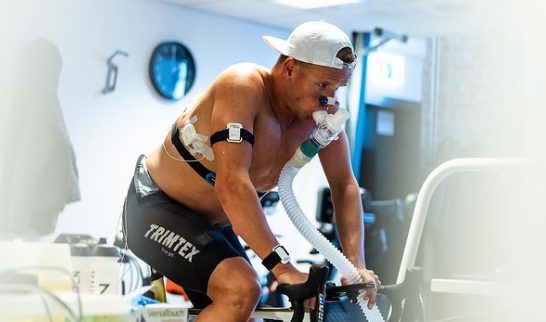
The endurance community has been buzzing recently after footage surfaced of triathlete Christian Blummenfelt allegedly achieving a staggering VO₂ max score of 101. However, leading exercise physiologist Professor Mike Ormsbee took to LinkedIn (see here) to raise some eyebrows regarding the validity of Blummenfelt’s score.
Ormsbee pointed out that in the video of Blummenfelt’s VO₂ max test, the Respiratory Exchange Ratio (RER) was recorded at 0.93. This indicates that it wasn’t a true max test, as VO₂ max testing typically requires an RER above 1.1. Additionally, the test lasted over an hour and 14 minutes, which is unusually long; most VO₂ max tests are completed in about 20 minutes.
While Ormsbee certainly recognises Blummenfelt as an exceptional athlete, he questions the legitimacy of the reported VO₂ max score of 101. So, the next time you come across astonishing VO₂ max scores circulating online, it’s worth digging deeper into the testing protocols and equipment used!
If you’re interested in learning more about VO₂ max, be sure to check out my blog VO₂ max (click here).
From us this week:
>> New course: The Role of a Performance Analyst
>> New podcast: Peak Demands and Decision-Making Under Fatigue with Stan Parker
>> New infographic: Nutrition For ACL Rehabilitation
>> New article: Hydrotherapy
Access to a growing library of sports science courses
SFS Academy is an all-access membership to premium sports science education.
With SFS Academy, you’ll learn from some of the best coaches around the world as they teach you how to apply the latest research and practice with your athletes.